



Last week, our team had the privilege to attend The Holi Festival of Colour at Kismet Estate Winery.
Located on the back lawn overlooking a small lake, with stations for different colours, sacks of blues, yellows, and pinks sprinkled throughout, as well as water balloons and even pichkaris (water guns), the event felt like the perfect place for multiple generations to come together and enjoy the celebration.
Because at its core, Kismet embodies a space where both heritage and history walk hand-in-hand with the next generation.
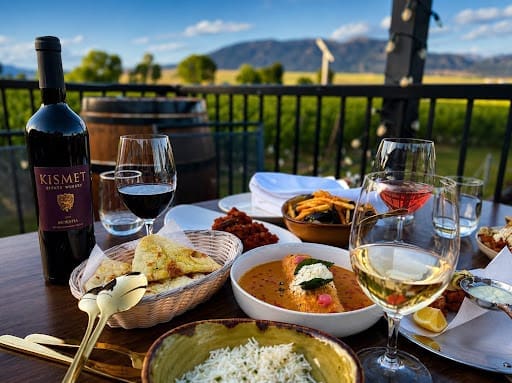
If you haven’t heard of Kismet before, allow us to be your formal introduction: it’s a family-owned winery in Oliver producing award-winning wines from estate-grown fruit farmed by the Dhaliwal family across 600 acres. It is where wine, food, culture, and family align in the South Okanagan.
Visitors can experience the winery through a variety of offerings: the tasting room, wine club, Manzil Restaurant, cultural celebrations, live music, corporate experiences, private events and weddings, and even upcoming luxurious on-site accommodations.
“Our goal is to create a destination that reflects both where our family came from and the future we see for wine country,” explains Neelman Dhaliwal. “Our winery experience brings together decades of grape-growing knowledge, second-generation winemaking, Punjabi heritage, and Indian hospitality.”
Already a well-respected name in the wine capital, the Dhaliwal family have stewarded this land for years, building off their rich cultural heritage and pioneer farming history. This level of excellence has not gone unnoticed, and recently, the winery has received a slew of much-deserved recognition.
Here are just a few:
- Silver at the Decanter World Wine Awards for 2021 Moksha and 2022 Cabernet Franc Reserve
- Gold at WineAlign’s National Awards of Canada for 2021 Moksha and 2020 Virsa’
- Double Gold at the All Canadian Wine Championships for their 2025 Pinot Grigio
- James Suckling recently awarded 93 points to both the 2022 Cabernet Franc Reserve and the 2020 Mantra
In addition, this season Kismet introduced Virsa, meaning “heritage” or “legacy” in Punjabi. This remarkable wine is crafted from the top one per cent of each vintage, and will change year to year depending on the growing season and winemaking decisions. With an inaugural release of only 58 cases, it truly is testament to dedication.
Because at Kismet, every bottle celebrates a family past rooted in exceptional craftsmanship.
The name of the winery itself means “Fate” or “Destiny,” and when you learn about the story behind this family-run business, you can’t help but agree.
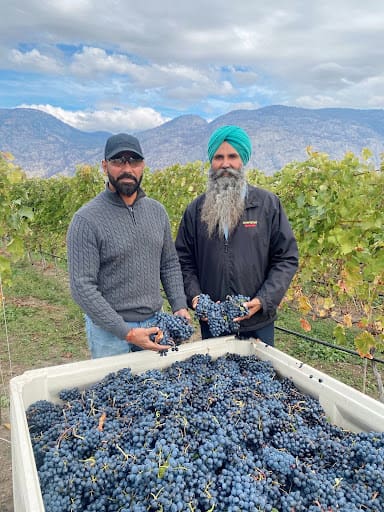
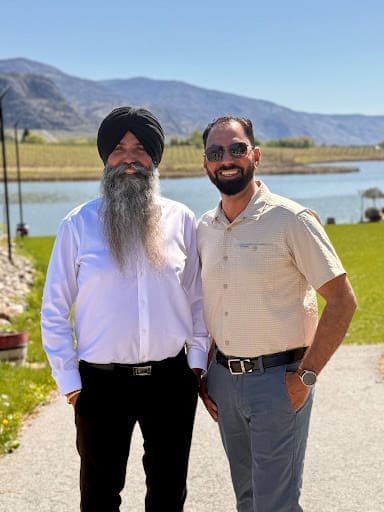
Pictured Here: Brothers/Founders Sukhi and Balwinder Dhaliwal
Where It Started: A History of Farming Heritage
At the core of any business is a foundation built on trust—a trait Sukwinder “Sukhi” Dhaliwal and Balwinder Dhaliwal displayed decades ago.
Long before the winery put itself on the map, these two brothers played a quieter but nonetheless integral role in the Okanagan wine industry: providing high-quality fruit that winemakers trusted.
In the early 1990s, the brothers came to Oliver with almost no money, limited English, and no background in viticulture. But they did have extensive knowledge after a childhood spent farming rice, wheat, and corn in Punjab. So while the grapes came with new techniques, new timing, and a completely different climate, the instinct and discipline towards farming did not.
For years the Dhaliwal brothers played a hand in many of the Okanagan’s most recognized labels: Blasted Church, CedarCreek, Gray Monk, Sandhill, Tinhorn Creek, Red Rooster, Road 13, Black Hills, Mission Hill, and Hester Creek. Vine by vine, harvest after harvest, they worked as vineyard labourers before they purchased their first 10-acre parcel in 1996. By 2010, they farmed hundreds of acres and produced almost 1,000 tonnes of grapes a year.
Today, only a small selection of their fruit is reserved for Kismet—roughly 10%—allowing them to remain focused on quality over quantity.

The first generation built the agricultural base, moving from vineyard labourers to land ownership and finally to a winery of their own. Today, that torch isn’t just being passed on—it’s igniting into a bright future of Okanagan winemaking with three new faces: Neelam Dhaliwal, General Manager; Gaganjit Dhaliwal, Vineyard Manager; and lastly, Manpreet Dhaliwal, Canada’s first and only South Asian female Head Winemaker.
“Watching Manpreet grow into this role has been one of the proudest moments for our family,” said Balwinder Dhaliwal, Co-Founder of Kismet Estate Winery. “She brings curiosity, discipline, and a real respect for the vineyard into every decision she makes. These awards are recognition of her talent, but they’re also proof of what’s possible when decades of farming experience meet a new generation of winemaking.”


Pictured Here: Manpreet, Sukhi, Neelman, and Baldwinder (left); Neelam and Manpreet (right)
The Second-Generation: Three Faces of Kismet Today
“Being part of the second generation is both an opportunity and a responsibility,” admits Manpreet Dhaliwal. “I have the benefit of working with fruit from vineyards my family has spent decades learning, and I want the wines to honour that history while also reflecting my own voice as a winemaker.”
Manpreet had begun a successful career in nursing when she decided to pivot to the cellar at age 26. Her first vintage earned 14 awards across nearly every release, and the recognition just keeps coming. Recently, you may have seen her name across the media as one of the 30 Under 30 nominees by BCBusiness, and she’s also been selected as one of Drishti Magazine’s Influential Women of the Year.
“To have my work recognized alongside women who are making an impact across so many different industries is incredibly special,” says Manpreet. “Representation matters to me, but so does being able to back that representation up through the work.”
Of course no one person created Kismet, and no one person runs it. Manpreet is joined by both her sister and cousin as the faces of the second-generation.
“I believe exceptional hospitality should be at the core of every business,” explains Neelam Dhaliwal, who oversees winery, restaurant, event, and hospitality operations. “Consumers can buy great products almost anywhere, but what they truly remember is how they were treated and how a business made them feel.”
A rewarding aspect about Kismet for her is meeting all the different people who visit the property. “Some guests arrive because they are interested in wine, then discover Indian dishes or cultural traditions that are new to them,” explains Neelam. “Others come for Manzil and leave with a deeper appreciation for Okanagan wine. We also welcome South Asian guests who tell us they feel proud to see familiar flavours, words, and traditions represented in wine country.”
It’s these moments that remind her of the strength of hospitality and how it can bring people together. “We are not only serving wine or food,” Neelam says. “We are creating opportunities for conversation, curiosity, and connection.”
Neelam is leading the operational and hospitality side of Kismet, shaping how guests encounter the winery, Manzil, events, The Hangar, and more. But when it comes to viticulture and carrying the family’s farming legacy forward, that role belongs to Gaganjit Dhaliwal.

“Our parents built Kismet from the vineyards up,” says Gaganjit, “so for me, shaping the future starts with continuing to care for the land and finding better ways to farm. We are building on decades of knowledge while also using new ideas, technology, and a more detailed understanding of each site.”
His approach to vineyard management focuses on what the site needs rather than forcing a one-size-fits-all system across every block—an approach his uncle and father honed before him. With over 50 sites, that means a lot of attention goes towards soil, elevation, grape variety, water, canopy, and weather.
“That level of observation helps us make better farming decisions and select the right fruit for each wine,” explains Gaganjit.
Of course, as many in the Okanagan know, climate volatility is one of the greatest challenges facing the wine industry. Growers have to work through winter damage, heat, wildfires, and more. But this reinforces how farming has always required patience and adaptability, something the Dhaliwal family has cultivated over the decades.
And what sets Gaganjit apart isn’t just his continuation of the family’s farming knowledge into another generation, but his work as a helicopter pilot, adding a rare connection between the scale of the land and his appreciation for it.
“The best view is when you can see the vineyard rows stretching through the valley, with the mountains and lakes framing the land between Oliver and Osoyoos,” says Gaganjit. “From the air, you can understand the scale of the vineyards and how much the landscape changes within a short distance. I love watching people realize that every bottle begins with this much geography, planning, and care.”
Of course, this level of perspective is entirely due to the first generation’s decades of hard work.
As Neelman says, “The beautiful tasting room, labels, events, and guest experiences are only possible because of years of farming, financial planning, regulation, staffing, production, and relationship building behind the scenes.”

Kismet’s first generation came to Canada with very little and built a respected legacy through years of physical work, perseverance, trust, and strong relationships. The second generation now has the opportunity to carry that legacy forward with exceptional hospitality, dedicated vineyard management, award-winning winemaking, and exciting new guest experiences—all while keeping their cultural identity and Punjabi heritage as an integral part of the operation.
We look forward to sharing a glass with them and enjoying a delicious meal at Manzil in the near future.
Xx,
Your Okanagan Curators
We asked Neelam Dhaliwal the following questions.
My favourite project/focus within my company is:
Building the full Kismet hospitality experience and finding new ways to bring our wine, food, culture, and family story together for guests.
My favourite product is:
Cabernet Franc. I love its depth, structure, and balance, and how well it reflects the quality of the fruit coming from our family’s vineyards. It is also a wine that pairs beautifully with the bold, layered flavours we serve at Manzil.
My favourite way to rest and reset is:
Sharing a quiet meal with family and having time together without an event schedule, service, or deadline attached to it.
Three things that helped me get to where I/we am/are today is:
Family, resilience, and the willingness to keep learning.
1 Book(s) or Podcast(s) I would highly recommend is:
One book I recommend is Start with Why by Simon Sinek. It explores the importance of leading with purpose and understanding the “why” behind what you do, rather than simply focusing on the product or service itself. As our family business transitions into its second generation, it really resonated with me and reinforced the importance of creating meaningful experiences, staying true to our values, and leading with intention.
Share three to five Okanagan businesses that are doing amazing things:
- Azhadi Vineyards. They are another family-owned winery that we have a good long term relationship with. They’ve created something truly unique by blending their Persian roots & culture with exceptional hospitality and world-class winemaking.
- District Wine Village. I love what they’ve created by giving smaller wineries and local businesses a place to grow together. It reinforces that when one winery succeeds, it helps elevate the entire region.
- Sustainable Winegrowing BC. They’re helping shape the future of the BC wine industry by encouraging environmentally responsible, socially conscious, and economically sustainable practices.
Jul 28, 2026

Read the Comments +